Fed Proposes Capital and Reserve Rules for Bank-Issued Stablecoins Under the GENIUS Act
The two proposed rules would require one-to-one reserve backing in cash and short-term Treasuries, plus a graduated operational-risk capital charge starting at 2% of outstanding stablecoins and stepping down as issuance scales. Regulators say issuers that fall short of the standards could face mandatory liquidation and redemption.
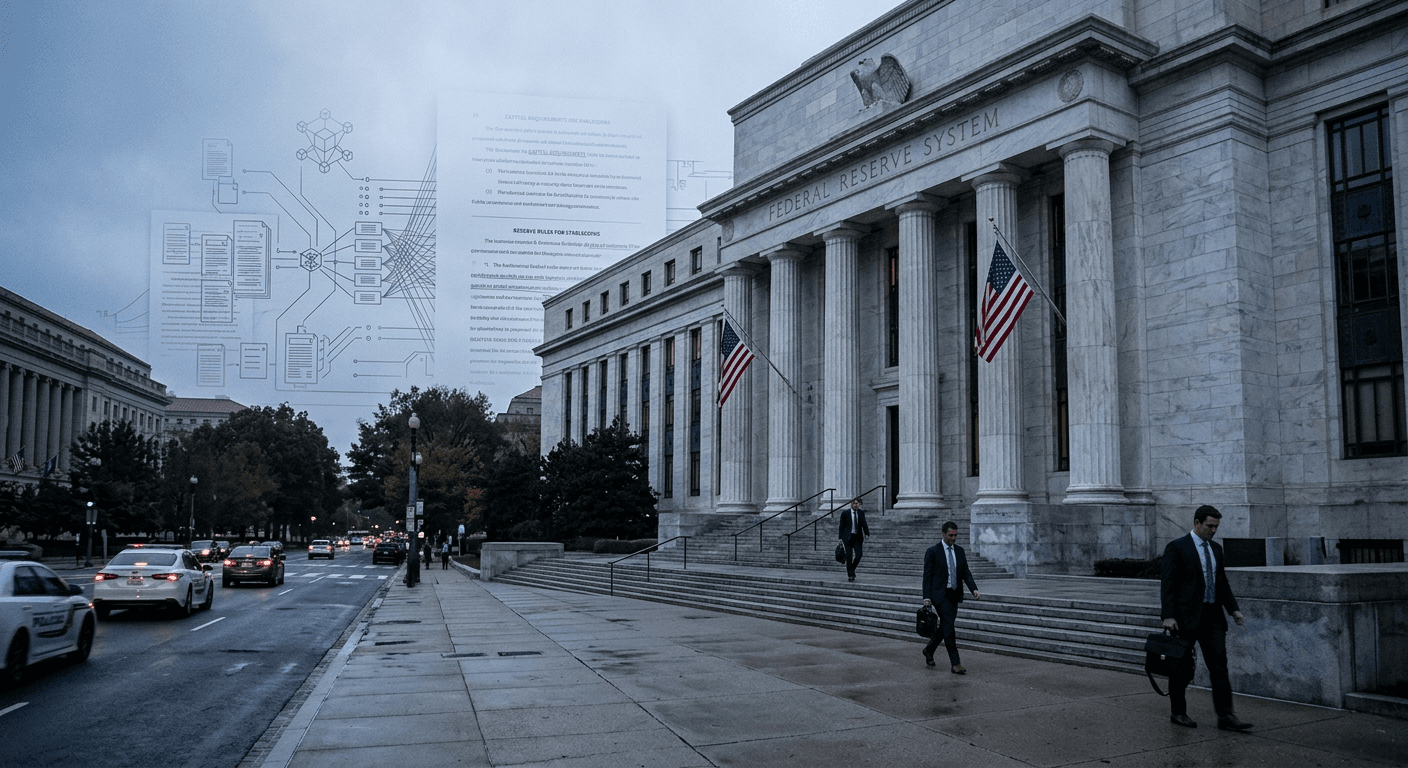
WASHINGTON — The Federal Reserve Board on Sept. 24 proposed two rules to implement the GENIUS Act, the federal stablecoin framework Congress passed in 2025, laying out for the first time the specific capital and reserve standards that Board-supervised payment stablecoin issuers will have to meet.
The core reserve requirement is one-to-one backing: every dollar of outstanding stablecoin has to be matched by cash or short-term U.S. Treasuries held in reserve, with the Fed's proposal explicitly excluding riskier or less liquid assets from counting toward that backing. On top of the reserve rule, the proposal introduces a standardized operational-risk capital charge that scales down as an issuer grows — 2.0% of outstanding stablecoins for the first $20 billion issued, dropping in steps to 1.0% for amounts above $50 billion — plus a separate 2% charge applied to any reserve assets the Fed considers to carry credit risk.
The rules also spell out consequences for falling short: an issuer that fails to maintain the required capital or reserve levels can be forced into mandatory liquidation and redemption, a considerably harder backstop than the informal expectations that have governed stablecoin issuance up to now. The proposal is open for public comment before the Fed finalizes it, and the agency has not set a specific effective date.
The timing lands in the middle of a wave of bank activity built around stablecoins — from national trust charter applications at firms like Agora and Bastion, to bank-issued stablecoins from MVB Financial, U.S. Bank and SoFi, to a newly announced consortium of 21 banks planning a jointly issued dollar stablecoin. A firm capital and reserve regime from the Fed gives all of those efforts a concrete compliance target, but it also means the more optimistic issuance plans now have to be underwritten against a specific capital cost that wasn't previously known.
For any bank or fintech weighing whether to issue its own stablecoin rather than distribute someone else's, the graduated operational-risk charge is the detail worth modeling first: a smaller issuer pays a full 2% capital charge on every dollar outstanding, while an issuer that scales past $50 billion pays half that rate on the marginal dollar — a structure that meaningfully favors scale and could accelerate consolidation toward a small number of large stablecoin issuers rather than a wide field of small ones.