Apollo's Chief Economist Warns AI Agents Could Trigger an 'Agentic' Bank Run
Torsten Sløk argues that AI agents capable of automatically moving household cash out of low-yield checking accounts and into higher-yielding fintech accounts could drain the cheap deposits banks rely on to fund lending — a systemic risk he frames as forward-looking rather than active today.
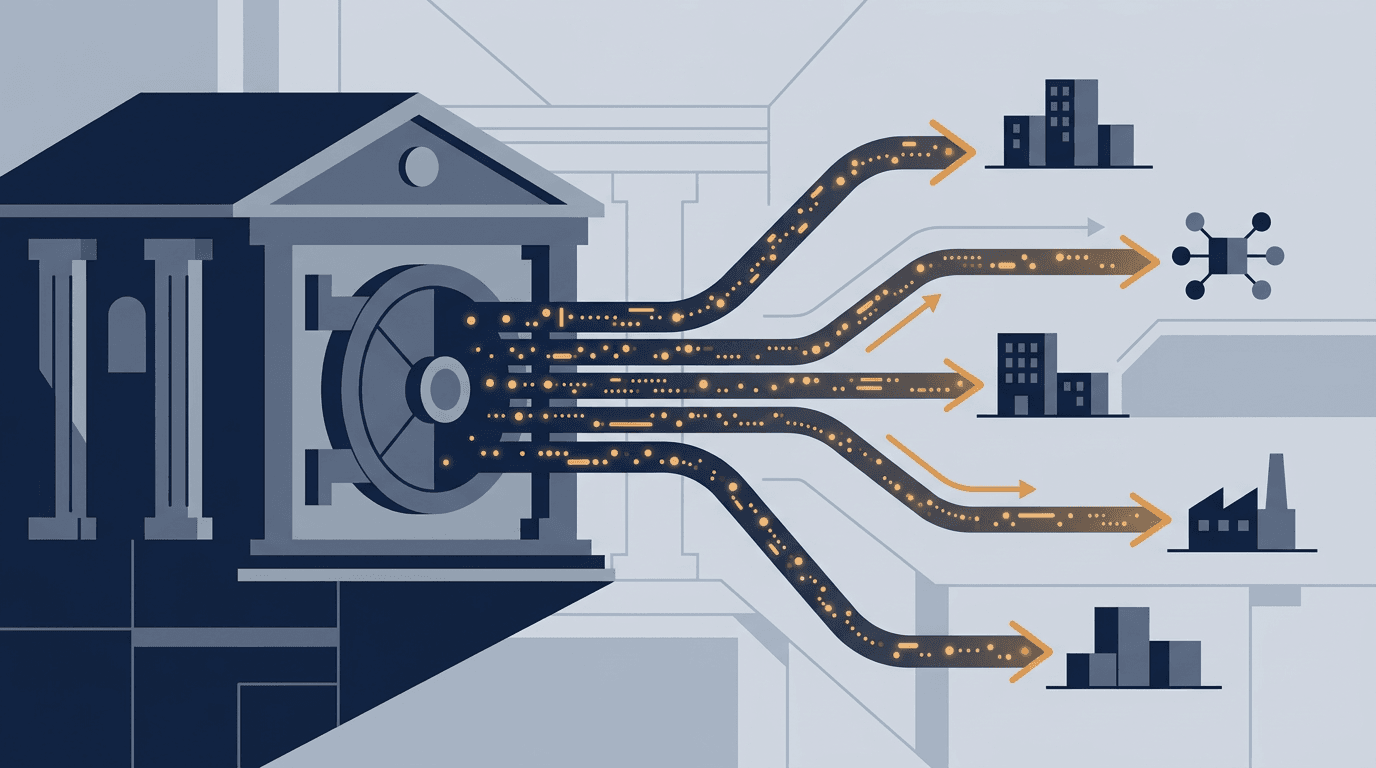
NEW YORK — Torsten Sløk, chief economist at Apollo Global Management, has warned that AI agents acting on behalf of consumers could eventually trigger what he describes as an "agentic" bank run — a scenario in which automated software, rather than panicked depositors, moves money out of traditional bank accounts en masse.
The mechanism Sløk describes starts with the wide gap between what banks pay on ordinary checking accounts, which he puts at around 0.1% in typical cases, and what fintech and neobank accounts advertise, which he cites in a 3.3% to 5.0% range. Today, most consumers do not act on that gap because comparing and switching accounts takes effort. Sløk's argument is that an AI agent instructed to optimize a user's cash for yield would not have that friction: it could continuously scan for better rates and move funds automatically, at a speed and scale no human depositor base would replicate on its own.
That matters for bank funding models specifically because checking deposits are the cheapest and stickiest source of funding banks use to make loans. A bank's ability to lend at scale rests partly on the assumption that a large base of low-interest deposits will not move quickly even when better rates exist elsewhere. If AI agents remove that stickiness by automatically chasing yield on depositors' behalf, Sløk's concern is that banks could see deposit outflows happen faster and more uniformly than in a conventional bank run, which typically depends on depositors independently deciding to act, often in response to solvency fears rather than simple rate-shopping.
Sløk is explicit that this is a forward-looking risk rather than something occurring today: consumer AI assistants such as Meta's Muse do not currently have the ability to initiate bank transfers on a user's behalf. The warning is directed at where agentic AI capabilities are heading rather than at an active deposit flight already underway, and it has not been accompanied by specific data showing deposit outflows attributable to AI agents to date.